Waste management and public health: the state of the evidence
Summarising the evidence
5.1 Introduction to judgements
The model for making judgements which was described in Section 1.3.3 was applied to the evidence on waste management in sections 5.2 to 5.5. A summary of the process is shown in Appendix 2.
5.2 Landfill
5.2.1 Reviews and primary studies
The literature search revealed more than 220 papers published about the hazards to health from landfill sites. Of these, 101 were primary studies about the health impacts of landfill sites and 23 about the health impacts of contaminated drinking water (Table 10). Six review papers were found which covered the epidemiological evidence linking health effects with landfill sites (see Appendix 4).

Table 10: Health outcomes investigated in primary studies of landfill sites
The drinking water studies were included in this section because an important source of exposure from landfill sites is leachate into groundwater. However, in many studies, the source of the contamination was not known. In some studies the source was leaking chemical storage tanks, in others, chemical accidents. Studies were not included if the water was contaminated by sewage.
Only seven of the total were occupational health studies, the rest being studies about the health impacts on nearby communities.
The types of studies carried out included case control studies, cross sectional studies, cohort studies, cluster analyses, correlation studies and descriptive surveys. Results were inconsistent, with some showing associations between landfill and various health impacts while other studies found no associations. In the largest review, of 41 single site studies and 10 multisite studies, correlations were found for some health outcomes in some of the studies but not in all (Vrijheid 2000). Authors who make definite statements that their study reveals real excess risks are frequently challenged (Staff 1998, von Mühlendahl 1999, Greenacre et al 2000). All of the primary studies are hypothesis-generating studies rather than hypothesis-testing studies.
5.2.2 Judgement
In reviews, discussion papers, conferences and consensus meetings, many attempts have been made to determine whether the findings indicate real risks associated with exposure to landfill sites. There is general agreement with the cautious position taken at a meeting convened by the WHO Regional Office for Europe in 1998 which concluded:
"Many of the studies detected an increased risk of the studied diseases and symptoms in populations living close to the landfills. However, the evidence supporting the causality of the association is inconsistent and inconclusive. Probably the strongest suggestion for causality was generated by studies on reproductive outcomes, such as reduced birth weight or some birth defects. However, all studies lacked direct exposure assessment, and the limited sample size of most studies makes a more specific analysis impossible. … Considering all the uncertainties, the meeting concluded that the present data do add to a suspicion that population exposure to emissions from hazardous wastes may pose a risk to population health. The present studies are not powerful enough to indicate which of the characteristics of the very inhomogeneous group of landfills that are included in the studies might be responsible for the observed small increase in the risk."
(WHO meeting 1998.)
Substantially similar conclusions were reached by other authors of discussion papers or consensus documents (Rushbrook 1990, National Research Council 1991, Morris 1995, Kipen 1996, Miller 1996, Johnson 1997 for the US Agency for Toxic Substances and Disease Registry, IEH 1999, Vrijheid 2000).
Overall judgement
Exposure to landfill and any health outcomes – insufficient.
5.3 Incineration
5.3.1 Reviews and primary studies
The literature search yielded 5 reviews, 24 discussion papers and at least 51 primary studies of the health impacts of incineration (Appendix 4 and Table 11).

Table 11: Health outcomes investigated in primary studies of incineration
Incineration is a method of processing waste during which major portions of the waste stream are physically and chemically transformed. Incineration produces energy, gases which are emitted into the atmosphere and solid residues which must be disposed of. The main hazards arising from incineration are toxic metals (such as lead, cadmium, arsenic and mercury), dioxins and particulates. Metals are not destroyed by incineration but are liberated from their immobilised state in waste materials and are released by combustion as highly bioavailable forms. They leave the incinerator in particles of respirable size, in particulates which are deposited on soils, water, food and dust, and in readily confounding factors inherent in these types of epidemiological study (described in section 4.2) rule out any definitive statement of causality. The lack of consistency in finding associations could mean that incineration does not cause the adverse health effects or it could mean that the health effects are not detectable using existing epidemiological methods and the available data.
5.3.2 Judgement
Incineration and any health outcomes – insufficient.
5.4 Composting
5.4.1 Reviews and primary studies
Two review papers were found of the health impacts of composting (Maritato et al 1992, Environment Agency 2001). The main health impacts from composting (Bunger et al 2000) are:
• Inflammatory responses of the upper airways – congested nose, sore throat and dry cough
• Toxicoses – toxic pneumonitis due to endotoxins
• Infections – respiratory tract and skin
• Allergies – bronchial asthma, allergic rhinitis, extrinsic allergic alveolitis (hypersensitivity pneumonitis)
The people most likely to be affected are workers in centralised composting facilities. Of the primary studies of health impacts, one is a case control study and the rest are case reports. The case control study (Bunger et al 2000) found that compost workers had significantly more symptoms and diseases of the airways (p=0.003) and the skin (p=0.02) than the control subjects and they had significantly increased antibody concentrations against fungi and actinomycetes. No studies were found about the health impacts to residents living by composting facilities.
From its assessment of the hazards and the potential health consequences, the Environment Agency has produced a position paper outlining regulatory and health and safety guidance to prevent exposure. (Environment Agency 2001).
5.4.2 Judgement
Composting and occupational health effects – probable.
Composting and health effects to residents – insufficient
5.5 Sewage discharges
5.5.1 Reviews and primary studies
Seven review papers (Appendix 4), 3 discussion papers and 70 primary studies (Table 12) were found about the health effects of sewage treatment. These were either about the effects of sewage discharges in recreational waters or occupational exposure.
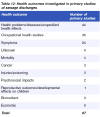
Table 12: Health outcomes investigated in primary studies of sewage discharges
Sewage discharges to recreational water
Most of the studies found a significant relative risk (1.0 < RR < 3.0) of contracting a disease, especially gastrointestinal symptoms, related to the number of indicator organisms present in relatively polluted recreational water (Pruss 1998, IEH 2000). The best dose-illness correlation was found with enterococci/faecal streptococci. Given the number of potential confounding factors, the pathogen threshold level for increased risk is still controversial. For example, it is possible that increased immunity in adult populations and in populations of countries with higher endemicity may result in higher threshold levels. Different countries detect different ranges of pathogens in water and use different detection methods.
The reliance on indicator organisms to define water quality has been frequently criticised as these organisms are now considered to be a poor indicator of the risks associated with viruses, protozoa and even bacteria. It has been shown (e.g. Deuter et al 1991) that there is a poor correlation between waterborne human viruses and faecal coliforms in marine water. Many pathogens survive longer than faecal indicator bacteria. Infective doses of viruses and protozoa are still present after 99.9% removal from raw sewage by secondary treatment methods (Ashbolt 1996). Pathogens undetectable by conventional methods can remain viable in marine water. Also, pathogens may accumulate in sediments and plankton and can be released and become infective in suitable conditions (e.g. Henrickson et al 2001). New molecular cell culture techniques are now available for a more accurate detection of water quality (e.g. Josephson et al 1991).
Occupational diseases of sewage treatment workers
Compared with workers in other occupations, workers at sewage treatment plants suffered from more gastrointestinal tract symptoms, airways symptoms, fatigue and headache. No dose response relationship was found between cancer and exposure to agents commonly found in sewage treatment plants.
5.5.2 Judgement
Convincing
Gastrointestinal symptoms and bathing in sewage contaminated recreational waters
Probable
Gastrointestinal tract problems, headache, fatigue and airways symptoms and working in sewage treatment plants
Insufficient
Cancer and working in sewage treatment facilities
5.6 Soil amendments
5.6.1 Reviews and policy studies
As wastewater irrigation is banned in the UK, the only soil amendment discussed here is landspreading of sewage sludge.
A total of 43 documents were found about the health impacts of landspreading sewage sludge. Nine documents published since 1990 were reviews or discussion papers about the health hazards from sewage sludge. There were 21 primary studies about health hazards and one primary study of the health impacts. The latter was about the effects of Gram-negative bacteria on the health of workers at wastewater sludge facilities between 1979 and 1981 (Clark et al 1984).
A discussion paper (Health Canada 2000, Vol 2) described the risks to human health as minimal because:
• pathogens have a short lifespan and their persistent forms remain in the soil,
• metals are not usually metabolised by soil microorganisms and will persist in the soil,
• most pollutants bind to soil components,
• most organic compounds, i.e. dioxins, are broken down by soil microorganisms,
• most organic compounds do not migrate into surface or ground waters because they adhere to soil components,
• volatile organic compounds evaporate within 48 hours of landspreading.
However, there is a lack of understanding of the potential for transfer of toxic compounds to food and about the degradability and persistence of some toxic contaminants (Rogers 1996).
5.6.2 Judgement
Sewage sludge landspreading and health impacts – insufficient.
5.7 Summary of judgements
An overall assessment of the evidence linking waste disposal to an impact on health is shown in Table 13.
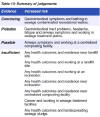
Table 13: Summary of judgements

